
I never want to forget this.
I cried, I cheered, and I watched as often as possible as these 33 men and 5 workers were pulled up through 2,000 feet of rock. how amazing! I am so glad these men didn’t give up in the 17 days no one knew they were alive. I would have never survived. I know we will really never know everything but I can imagine the despair they felt in the beginning. I can’t even imagine how their families felt and then the feelings they felt as they heard the news that their loved ones were still alive. How amazing.
I cried a lot during the 22 hours it took to rescue each of them. Seeing each man come out of the “fenix” tube and hug their loved ones made so proud of good people who did everything that they could to help people they didn’t even know!
History most definitely was made today. These 33 men survived the longest in a mine in world history! I am so glad I was able to “witness” this history.I am excited to get updates on them and see how they are doing since their rescue.
SAN JOSE MINE, Chile -- The last of the Chilean miners has been raised from deep beneath the earth. All 33 men have now been delivered from the longest underground entrapment in history.
The first of six rescue workers who went down to bring out 33 trapped miners is the last person to get back to the surface, leaving behind an empty, wrecked mine.
Manuel Gonzalez waited alone a half-mile down for 26 minutes while the escape capsule went up and came back down for him. He talked by phone with other rescuers at the top while waiting, joking that he was praying the capsule showed up.
Related Photos
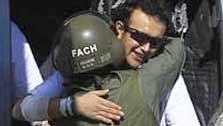
Trapped miners extracted from Chilean mine
A video feed showed him gesture triumphantly, then bow before making an awkward climb into the capsule, drawing cries of "Careful! Careful!" from those at the surface. Then he strapped himself in and shut the door before disappearing up the shaft.
In all, the operation took just over 24 hours after the first miner was pulled out at 12:11 a.m. Wednesday, a marathon broadcast on live television that captivated the world.
The mining foreman who held the group together when they were feared lost was the last of the rescuees out. He was hoisted to safety in a joyous ending to a flawless rescue that captivated the world.
(Programming note: Watch "Miracle at the Mine," ABC's special coverage of the Chile mine rescue, Wednesday at 10 p.m. PDT. The show will include live rescues and emotional family reunions as the miners see their loved ones for the first time in more than two months.)
Luis Urzua ascended smoothly through 2,000 feet of rock, completing a 22½-hour rescue operation that unfolded with remarkable speed and flawless execution. Before a crowd of about 2,000 people, he became the 33rd miner to be rescued.
"We have done what the entire world was waiting for," he told the Chilean president immediately after his rescue. "The 70 days that we fought so hard were not in vain. We had strength, we had spirit, we wanted to fight, we wanted to fight for our families, and that was the greatest thing."
As Urzua hugged and shook hands with rescue workers, he said, "Thank you. Thank you for everything. You have been excellent."
After 69 days underground, including two weeks during which they were feared dead, the men emerged to the cheers of exuberant Chileans and before the eyes of a transfixed globe. The operation picked up speed as the day went on, but each miner was greeted with the same boisterous applause from rescuers.
"Welcome to life," President Sebastian Pinera told Victor Segvia, the 15th miner out. On a day of superlatives, it seemed no overstatement.
They rejoined a world intensely curious about their ordeal, and certain to offer fame and jobs. Previously unimaginable riches awaited men who had risked their lives going into the unstable gold and copper mine for about $1,600 a month.
The miners made the smooth ascent inside a capsule called Phoenix - 13 feet tall, barely wider than their shoulders and painted in the white, blue and red of the Chilean flag. It had a door that stuck occasionally, and its wheels needed lubricating at least once, but it worked exactly as planned.
Beginning at midnight Tuesday, and sometimes as quickly as every 25 minutes, the pod was lowered the nearly half-mile to where 700,000 tons of rock collapsed Aug. 5 and entombed the men.
Then, after a quick pep talk from rescue workers who had descended into the mine, a miner would strap himself in, make the journey upward and emerge from a manhole into the blinding sun.
The rescue was planned with extreme care. The miners were monitored by video on the way up for any sign of panic. They had oxygen masks, dark glasses to protect their eyes from unfamiliar light and sweaters for the jarring transition from subterranean swelter to chilly desert air.
As they neared the surface, a camera attached to the top of the capsule showed a brilliant white piercing the darkness not unlike what accident survivors describe when they have near-death experiences.
The miners emerged looking healthier than many had expected and even clean-shaven. Several thrust their fists upwards like prizefighters, and Mario Sepulveda, the second to taste freedom, bounded out and led his rescuers in a rousing cheer. Franklin Lobos, who played for the Chilean national soccer team in the 1980s, briefly bounced a soccer ball on his foot and knee.
Yonni Barrios -- rescued miner number 21 -- wasn't greeted by his wife of 28 years. She wasn't even there. It was his mistress, whom he had been secretly seeing for years, who gave him a welcoming hug.
Health Minister Jaime Manalich said some of the miners probably will be able to leave the hospital Thursday - earlier than projected - but many had been unable to sleep, wanted to talk with families and were anxious. One was treated for pneumonia, and two needed dental work.
"They are not ready to have a moment's rest until the last of their colleagues is out," he said.
As it traveled down and up, down and up, the rescue capsule was not rotating as much inside the 2,041-foot escape shaft as officials expected, allowing for faster trips.
No one in recorded history has survived as long trapped underground. For the first 17 days, no one even knew whether they were alive. In the weeks that followed, the world was captivated by their endurance and unity.
Chile exploded in joy and relief when the rescue began just after midnight in the coastal Atacama desert. Car horns sounded in Santiago, the Chilean capital, and school was canceled in the nearby town of Copiapo, where 24 of the miners live.
News channels from North America to Europe and the Middle East carried live coverage. Pope Benedict XVI said in Spanish that he "continues with hope to entrust to God's goodness" the fate of the men. Iran's state English-language Press TV followed events live for a time. Crews from Russia and Japan and North Korean state TV were at the mine.
The images beamed to the world were extraordinary: Grainy footage from beneath the earth showed each miner climbing into capsule, then disappearing upward through an opening. Then a camera showed the pod steadily rising through the dark, smooth-walled tunnel.
Most of the men emerged clean-shaven. More than 300 people at the mine alone had worked on the rescue or to sustain them during their long wait by lowering rocket-shaped tubes dubbed "palomas," Spanish for carrier pigeons. Along with the food and medicine came razors and shaving cream.
Estimates for the rescue operation alone have soared beyond $22 million, though the government has repeatedly insisted that money is not a concern.
The men emerged in good health. But at the hospital in Copiapo, where miner after miner walked from the ambulance to a waiting wheelchair, it became clear that psychological issues would be as important to treat as physical ones.
Mining is Chile's lifeblood, providing 40 percent of state earnings, and Pinera put his mining minister and the operations chief of state-owned Codelco, the country's biggest company, in charge of the rescue.
It went so well that its managers abandoned a plan to restrict images of the rescue. A huge Chilean flag that was to obscure the hole from view was moved aside so the hundreds of cameras perched on a hill above could record images that state TV also fed live.
That included the surreal moment when the capsule dropped for the first time into the chamber, where the bare-chested miners, most stripped down to shorts because of the underground heat, mobbed the rescuer who emerged to serve as their guide to freedom.
"This rescue operation has been so marvelous, so clean, so emotional that there was no reason not to allow the eyes of the world - which have been watching this operation so closely - to see it," a beaming Pinera told a news conference after Avalos was brought to the surface.
The miners' vital signs were closely monitored throughout the ride. They were given a high-calorie liquid diet donated by NASA, designed to prevent nausea from any rotation of the capsule as it travels through curves in the 28-inch-diameter escape hole.
Related Content
Story: Special ABC Chile mine coverage to air 10 p.m.
Story: Chilean miners emerging to friends, families
Story: Dramatic endgame nears for Chile miners
Story: Miners face challenges when finally rescued
Story: Chileans hope to begin mine rescue Wednesday
Engineers inserted steel piping at the top of the shaft, which is angled 11 degrees off vertical before plunging like a waterfall. Drillers had to curve the shaft to pass through "virgin" rock, narrowly avoiding collapsed areas and underground open spaces in the overexploited mine, which had operated since 1885.
U.S. President Barack Obama said the rescue had "inspired the world." The crews included many Americans, including a driller operator from Denver and a team from Center Rock Inc. of Berlin, Pa., that built and managed the piston-driven hammers that pounded the hole through quartz and silica, some of the hardest and most abrasive rock there is.
Chile has promised that its care of the miners won't end for six months at least - not until they can be sure that each man has readjusted.
Psychiatrists and other experts in surviving extreme situations predict their lives will be anything but normal. Since Aug. 22, when a narrow bore hole broke through to their refuge and the miners stunned the world with a note, scrawled in red ink, disclosing their survival, their families have been exposed in ways they never imagined.
As trying as their time underground was, the miners now face challenges so bewildering that no amount of coaching can fully prepare them. Rejoining a world intensely curious about their ordeal, they have been invited to presidential palaces, to take all-expenses-paid vacations and to appear on countless TV shows. Book and movie deals are pending, along with job offers.

No comments:
Post a Comment